Tuesday, 31 May 2016

Presentation- Art Deco

In our presentation we included various elements that the style offered to the Maltese islands. Although their are only few landmarks or products that were made during the art deco period. We can mostly find architecture, products and fashion that were influenced by this movement.

My role in the presentation was to research on the style in general such as the characteristics influences and how the movement effected the social life during does days. I also researched on were can still find influences today. My general research about the movement helped the group and myself understand more what we were searching for when we went on our fieldwork. Knowing exactly what the characteristics of the style were helped us easily spot architecture and products that were made under the influence of art deco. I also made substantial research on the influences of this movement to further understand what triggered this style to be so successful in its peak. By observing these influences we could also understand were curtain shapes and forms came from.  Below are the slides I delivered:


I was the first to introduce the style to the audience, i started of by stating the origins that I had researched, the origins involved how society was involved in creating this movement. I also stated what was going on when art deco was born such as the end of the war and the influences it gathered from the machine age. I also stated what other movements influences art deco, such art nouveau, and also mentioned what were the specific characteristics that art deco artist used from this previous movement. In the introduction I also mentioned the pioneers of this movement, such as, Eugene Grasset and Raoul Lachenal and main exhibition they held in paris which eventually would be the starting point of this movement.


In the next slide I mentioned major influences and the impact it made on society. It left a huge impact on Hollywood as a lot of stage designers used this glamorous style for their movies. I also mentioned the materials that were mostly used in these sets and in everyday life. Another factor that i mentioned was the movements that were alive during the art deco period and how they them selves helped shape the movement.


On my third slide u mentioned the events that helped shape up the movement such as the ancient revivals. These ancient revivals included the Egyptian art, roman architecture and also Mayan architecture and arti facts. The biggest event to trigger this movement was the discovery of Tutankhamen, as his discovery triggered mass interest in Egyptian which would later be one of the main influences for art deco.


In my last two styles I gave a brief acknowledgment on what were the characteristics we can find in art deco designs, these included:   Geometric and Angular shapes, chrome, glass, shiny fabrics, mirrors and mirror tiles,   Nature motifs - shells, sunrises, flowers, Highly polished wood.

Overall I enjoyed working as a team an researching on this movement, I believe that this helped us be more familiar with the movement. I was also quite satisfied with my team members as everyone contributed to make the presentation as professional as can be. 


·         
·       
·         

Monday, 30 May 2016

Infographic

Infographic Process  

In order to do task 3 I chose art deco in for my infographic. It is one of my favorite styles as it has a combination of the decorative era and the contemporary modern style. I began by listing down the characteristics and influences of the style. I took into consideration the fact that the info-graphic purpose is to make the viewer easily understand what the topic is without a lot of text, to do this I shortlisted the main influences of the style and also the characteristics that determine the style. My first step was to apply a title, in my case I chose the one below. A neath designed title which i cropped using Photoshop, I also like the colours as they were highly used in art deco. Another fact why it was a good title is due to its typography, a typical typo that was frequently used in art deco.    

  As my title was done I could now easily relate curtain colours I was going to use in the rest of infographic. On the side of the title I added art deco influenced typography that an atrist created presently, I included these at the right and left side of my title, indicating their importance as the style still lives around us today. Although typography is not my specific subject I still think it is relevant to include in my info-graphic as it had a huge role for the character of this style. Another interesting factor is that the artist combined pop art and art deco.  


In the next step I gave colour to the background of the infographic and also applied simple yet effective lines that will act as lining under the wording. I filled the colours of the bar lines using the same colours that the border had. I chose the grey background as the colour was frequently included in art deco fine arts. The grey brownish colour also gave it a slight retro style.
In the next step I included the influences of the style under the title, this was done by using small sized typo so they would not disturb the title. 


By using an online grenadier NF font generator i created my text which included the styles characteristics in a font type that was used during the art deco era. This gave the viewer a clearer picture of the style and could already be recognized by this typo. I placed the wording accordingly on the bar lines. 


Then all that was left was to add appropriate images related to the wording. I chose the images as clear as possible to make it easy for the viewer to understand and visualize. Over all I was quite pleased with the outcome as i believe i managed to translate and help the viewer visualize the style I chose easily. I also made its design as clean and neath as possible to eliminate any confusion. 

Below is the final outcome


Art Deco- Info-graphic


Expressionism and Architecture


Expressionism

The expressionism movement emerged across Germany at the beginning of the 20th century and lasted till the 1930s, it later flourished to Austria, Denmark and other Nordic countries . The movement is all about how artists seek to express emotional experience rather than impressions of the external world. This made art more unique and personal as one could express his own individual feelings and emotions to the audience, this also made art more questionable and mysterious.
The expressionism movement was a response to the lost feelings humanity had to spirituality and the world around us due to political and social problems; it was also a part of a reaction against academic art and impressionism were as then both styles depicted real factual subjects.
Expressionist architecture
Expressionism is also evident in architecture were we can find many famous architects that were involved in this movement, such as; Bruno Taut, Erich Mendelshn, Walter Gropius, Mies van der Rohe and Hans Poelzig. Architects who were involved emphasized on shapes and forms that could be rarely found in architecture around that time. Just like expressionist fine artists, architects derived from realism and emphasized on how to implement forms and shapes that show their emotional feelings.


In the choice of materials architects opted to go for the representation rather than the function, they mostly used bricks, steel and glass. They highly believed that glass should be use in their design and as one the architects stated “Coloured glass destroys hatred”,”Without a glass palace life is a burden”,”Glass brings us a new era, building in brick only does us harm” (Paul Scheerbart, 1914 on the Werkbund Glass Pavilion)
Expressionism was an ideal style to implement in stage design as the stage created a deep emotional atmosphere to the audience. And just like stage designers designed their stage so did architects for their buildings, the architects main idea was to engage the viewer in an emotional atmosphere when observing its form. One of their main highlight is how light and shadow is effecting the design itself just like the example below; Casa Batllo which is situated in Barcelona and made by Antonio Gaudi. His designs give us a quick peep into his fantasy ideas, it almost looks unreal. This is a clear example how most of expressionist artist mostly mattered on looks rather than functionality.


The Einstein tower which was designed by Erich Mendelsohn between 1917 and 1920. The masterpiece is one of the best examples of German expressionist architecture. The designers main target was to link its form with the buildings function which was an observatory and a laboratory for Albert Einstein’s theory of relativity. Its flowing form also reflects the great scenes of artistic freedom that expressionists brought. On the other hand in this case although it brought curtain freedom in architecture Erich still observed symmetry and although it wasn’t necessary we can already see evidence that aerodynamic shapes were already in use.


We can also see contemporary expressionist architecture today. The Sydney opera house is a perfect example. Another interesting fact about the opera house is that it was one of the first sophisticated geometric buildings to be partially constructed by CAD. It was designed by Jon Utzon in 1956 and is mostly known for its shell structure, which again is showing the freedom to express and show new forms and shapes.


 Bibliography 


architectureintlprogram (2011) Expressionism in architecture. Available at: https://architectureintlprogram.wordpress.com/2011/03/30/expressionism-in-architecture/ (Accessed: 30 May 2016)

Koberstein, M. (2016) Available at: http://db.arts.usf.edu/data/stein/reader.asp?n=whatisexpressionism (Accessed: 30 May 2016)

Manet, É. (2016) Impressionism movement, artists and Major Works. Available at: http://www.theartstory.org/movement-impressionism.htm (Accessed: 30 May 2016).


Krystle S. (2010) Expressionism: A retrospective. Available at: https://www.youtube.com/watch?v=EVNly9jLbfE (Accessed: 30 May 2016).


Einstein tower - architecture of the world (1921) Available at: https://en.wikiarquitectura.com/index.php/Einstein_Tower (Accessed: 30 May 2016).

Art Nouveau


Art Nouveau 


Before the 1890's, to be considered as superior artists, one had to attend one of the an art's academies that were available at the time. In these academies an artist had to base their studies on line, shape, form and texture in order to fit the standards and produce realistic art work of figures and landscapes. On the other hand, their were some artists who criticised academic art as they believed art isn't meant to be realistic, for them art flowed from the soul, twists through the consciousness and decorates life with its beauty. These artists went on with their philosophy and were the pioneers of the very short but highly influential movement known as Art Nouveau. Due to this new style, artists moved away from imitating real subjects and moved to the twisting flowing forms and lines that nature owned. Overall the style is very organic due to the highly used whiplash curves most designs have.

Boutique Fouquet, by Mucha

Above we can see a typical interior designed by Alphonse Mucha, nature was his main inspiration as the room is full pf organic forms, Visiting these art nouveau interior is like visiting a small garden, it is also quite evident how these artists were in harmony whit nature.


Above is a chair maid by Hector Guimard in 1912, Its design can be easily linked to the praying mantis due to its thin legs and arms, it head rest also resembles the insects head due to the wholes he applied. Overall it is highly decorative and its ornamental piece which highly distinguish the movement. Natural materials such as wood were often used making the design even more organic. Craftsmanship was also highly emphasized during this movement as principles from the arts and crafts movement were still being observed by art nouveau artists.    


Art nouveau delivers its beauty till this very day as Paris is full of these metro entrances. In the image above I am showing the entrance to the Porte Dauphine metro station, one of the most famous entrances Hector Guimard designed to enlighten the streets of Paris. Inspired by nature and Japanese art due to its delicate leaf form, that serves as shelter. Hector also applied earth colours in order to create unity with the park that is situated around it.

In art nouveau designs the Japanese influence is quite evident. It was highly effective for the artist as Japan opened its doors for commerce during this period, these events exposed Japanese art such as the famous wood block prints. Due to this exposure European artists became highly influenced by the flowing designs that Japanese artists used in their art.  

Bibliography


Gaudi, A. (2016) Art nouveau movement, artists and Major Works. Available at: http://www.theartstory.org/movement-art-nouveau.htm (Accessed: 30 May 2016).


visual-arts-cork (no date) Art nouveau design: Characteristics, history, artists. Available at: http://www.visual-arts-cork.com/history-of-art/art-nouveau.htm (Accessed: 30 May 2016).


Architecture of the Paris Métro (2016) in Wikipedia. Available at: https://en.wikipedia.org/wiki/Architecture_of_the_Paris_M%C3%A9tro (Accessed: 30 May 2016).
Philinthecircle (2014) Art nouveau - overview - goodbye-art academy. Available at: https://www.youtube.com/watch?v=P4luPnObQYo (Accessed: 30 May 2016).

Thursday, 19 May 2016

Arts and Crafts Movement


The Arts and Crafts movement began in Britain and flourished to Europe and North America between 1880 and 1910, it later emerged in Japan in the 1920's. 


The key forces that triggered the Arts and Crafts movements
  • The Revival of Gothic Style 
  • The rejection of industrialization
  • The impact that mass production and machines had on craftsmen  


The movement was mostly upheld due to the poor quality in design during the industrial revolution, it was highly criticized by advocates of the arts and crafts movements. They believed that all the economical success and growth during the industrial revolution was destroying traditional skills as well as craftsman.This also effected the members of the movement as they were fine craftsman them selves, in other words this was effecting their own profession. Due to the impact that the industrial revolution was having on them and other craftsman they decided to encourage other artists, by including a medieval style in their work.

The arts and crafts movement also has its roots in the Gothic revival which became increasingly important throughout the nineteenth century, it later replaced classical styles in popularity. The key figure to this revival was A.W.N Pugin, whom emphasized on the truth to materials, structure and function. These characteristics will later be key principles for the arts and crafts movement.  
   
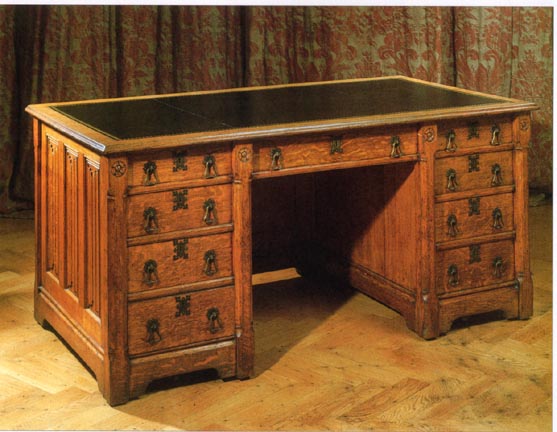
Gothic Revival Desk
Gothic Revival Desk by August W.N Pugin

William Morris

A British textile designer, writer, artist and also a socialist associated with the Pre-Raphaelite Brotherhood and the English arts and crafts movement. William Morris was one of the key figures of the movement and is well known for his wall paper design. his work highly reflected the love he had for nature as leaves and flowers where his main subject. 

Wallpaper design 

He began designing wallpapers in the 1860's, which at that time they where hand printed by Jeffrey and Co using traditional; printing methods that included wood block and natural based pigments. 


Above is a room decorated in the arts and crafts style by William Morris, with furniture by Phillip Web. In this example it is quite evident how much he believed in natural motifs in design. He gives life to the room by adding complex natural patterns to his wallpaper, he also gives his wallpaper natural warm earth colours in order to create contrast with the rest of the furniture.


Above is the sideboard which is located in the room I stated previously. It is an early example of furniture produced by Morris, Marshall, Faulkner and company, and designed by Phillip Web back in 1862. We can clearly see the relation to the medieval style, he also used oak to give it a dark tone. On the other hand Morris and co implemented arts and crafts characteristics by adding ornamental organic patterns on its surface. Gold is also added to some edges, hinges and drawer knobs, this highlights more detail and make it blend better with the rest of the room.


1. Arbutus WP Main MWPPC

In the image above I am showing how Morris's wallpaper designs still influence interior designers today. Its repetitive organic patterns can easily fill a room without being disturbing to the eye. And although his wallpapers are full of organic flowing shapes, modern sharped edged furniture can still be used together.      

References 

https://www.william-morris.co.uk/shop/wallpaper/

https://beatwicki.wordpress.com/2010/02/09/philip-webb/

https://www.youtube.com/watch?v=tYjNO2Y4m6c

http://www.britannica.com/art/Arts-and-Crafts-movement/images-videos


Saturday, 30 April 2016

The industrial revolution and how it effected society and design


The Industrial Revolution


Before I started my research on what was going on during the industrial revolution, I took a look and acknowledged myself on what triggered this massive turning point in the history of mankind. We state that it is a turning point because it changed the manner of how people lived. The industrial revolution was a series of events that occurred in about 200 years, which began in Great Britain and spread to Western Europe and the United Sates. 


Pre Industrial society

Before the industrial revolution the majority of the population lived in the countryside where most families had their own land. They grew crops and held farm animals for home consumption. In the beginning of the eighteenth century the agricultural revolution took place, this revolution created new and better ways of crop rotation and livestock utilization. This also gave the ability to farmers to create a diversity of wheat and vegetables and also gave them the ability to support more livestock. This increased food production and so the British population could now be fed at low cost and with less effort than before. This change had an impact on society as the population became better nourished and healthier. Later during the agricultural revolution the government introduced enclosure acts, these acts allowed the wealthy to purchase public fields and push out small scaled farmers. This meant that the agricultural revolution created a great environment for industrialization as these workers provided labour to new industries during the industrial revolution. 


Industrialization
Design changed in the same way society changed, prior to the industrial revolution manufacturing industries were often handmade and done in homes, it was done using traditional tools and basic machinery. During the industrial revolution a number of inventions took place and due to these inventions these industries were transformed by the industrialization that was taking place. These inventions also affected wester foreign countries, due to migration. Invention were replicated or developed depending on their requirements. An embargo act took place in America which restricted curtain British products. This created a greater need for America to produce their own goods domestically.  

Key technological inventions during the industrial revolution


The cotton industry was one of dose technological changes which without them the industrial revolution wouldn’t have happened. It all started from the spinning jenny, an invention by James Hargreaves in 1768. This machine allowed the person using the machine to spin multiple balls of yard instead of using just one at a time. This made the process much faster, it also started being used for mass consumption.

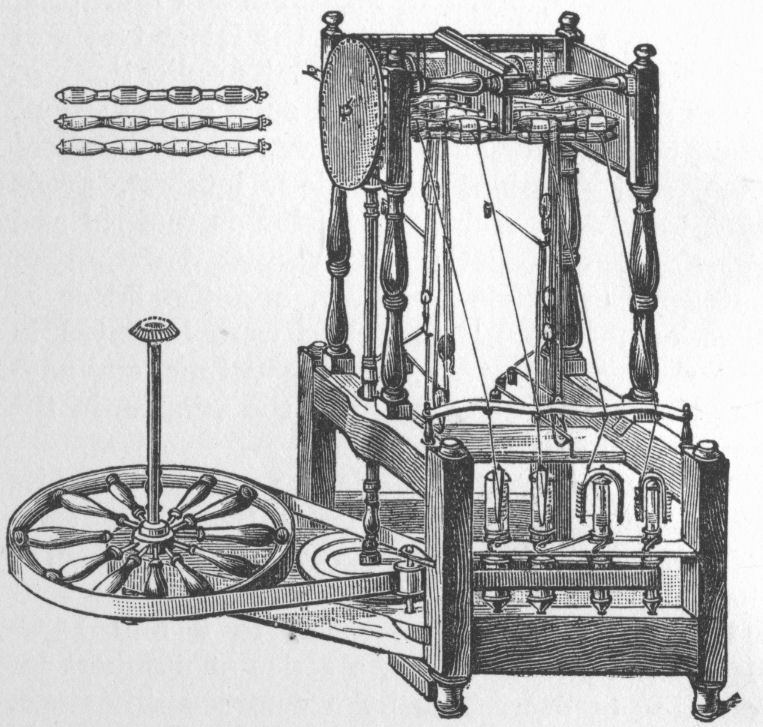
The Spinning Frame By Richard Arkwright 

Later Richard Arkwright went on to improve the yarn production by inventing the spinning frame. His main objective was to speed this process up. It was a machine that worked by a water power wheel, this machine could be replicated and make factories as big as he wanted as long as there was a good supply of water. Due to this factor factories had to be built near rivers because of the machines demand for water. Historians state that Arkwright didn’t just invent the spinning machine but he also invented the modern factory. These factories created jobs and soon enough Britain became a power house.


The Steam engiine


The steam engine was another great success from the industrial revolution, James watt wasn’t the inventor of the steam engine but is known for making the first reliable and for perfecting the steam engine. These engines were powered by coal or by steam, and this allowed factory owners to have greater control on were they wanted to build their factory. The steam engine also contributed in the development of railroad technologies improving transportation. This meant that civilians and goods could be transported faster and easier.  


Iron making 
Iron was also a key mineral for the industrial revolution, it was growing and changing at a fast pace due to its demand. It was even more at a demand after inventors discovered a more efficient and less expensive method to produce cast iron. Later a process was developed in order to refine iron which created a strong product which could be easily used in all kinds of factories to manufacture their goods.


The Crystal Palace 
The Crystal Palace was a cast iron and plate glass structure built to house the 1851 great exhibition. More than 14,000 exhibitors participated in order to show the achievements that were developed during the industrial revolution.  


Mass production during the industrial revolution 


Impacts on design
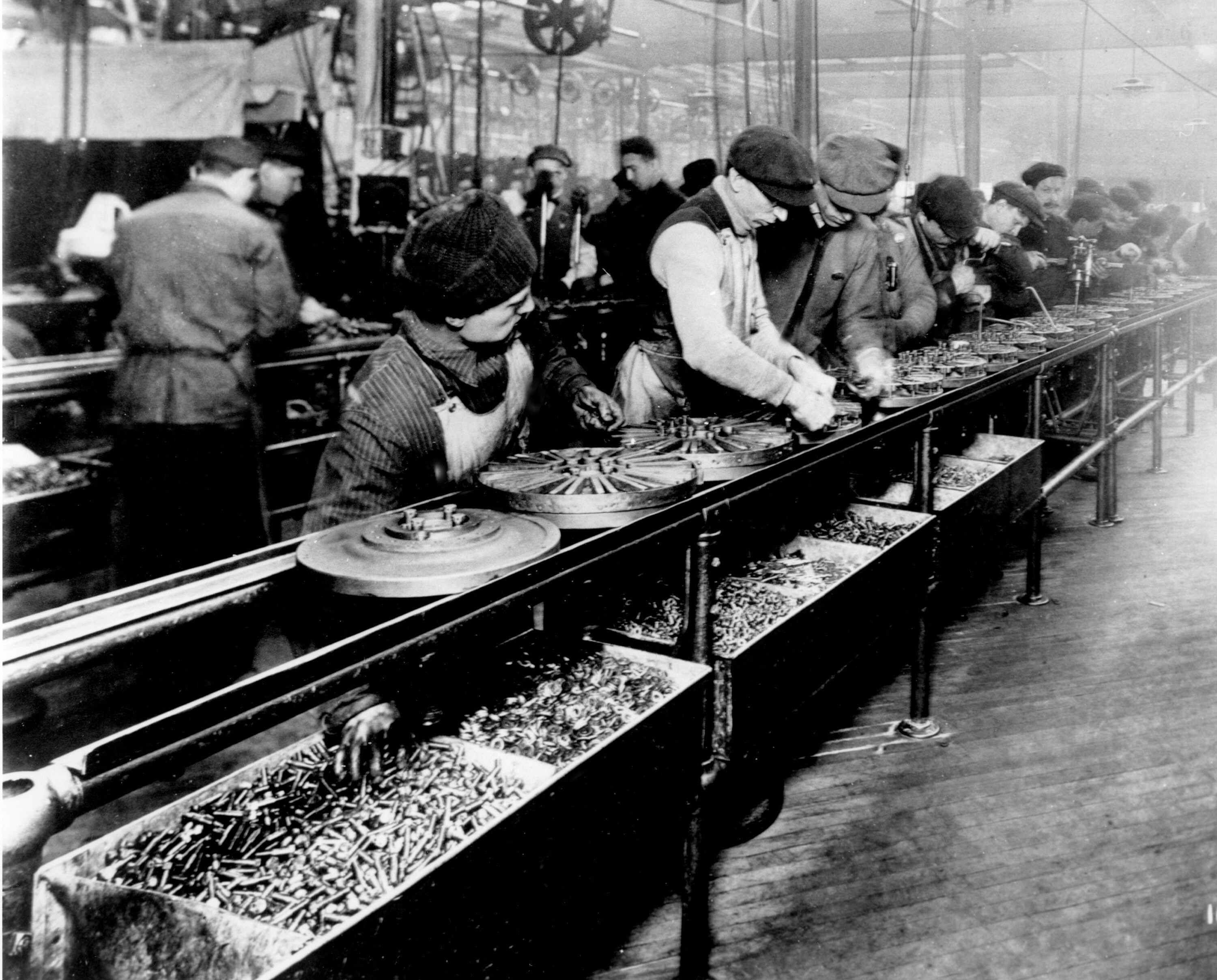
Design was shaped and changed during the industrial revolution due to mass production and mass consumption. Before the rise of mass consumption products were manufactured on a made to order basis by skilled craftsmen. On the other hand mass production gave manufacturers the ability to produce consumer needs in large quantities; this resulted in lower prices for consumers. Producing in the mass comes as an advantage for manufacturers as products can be made in same amount of time as producing products individually. Factory owners also realised that products that were made handmade were resulting in more money spent paying wages to people that were manufacturing the parts. Later on when machinery was well developed, objects could then be made using molds and robotical equipment. Another effect that mass production made was that human workers didn’t need to be trained professionally to do the job, this came at an advantage for factory owners as workers required lower wages. 


Characteristics that products had before and after the the industrial revolution

Pre-Industrial design

made for small markets, client selected their designs meaning that each and every product could be custom made, made by hand by artists and crafts workers, used rare materials with luxurious elements, traditional, good quality and valuable.  
   
Post-industrial design

 Made for the middle class in large quantities for biggest markets, appealed to bankers, merchants and industrialists, popular and mass produced products, economical, practical materials, inexpensive and replaceable 


Pioneer industrialists / producers of industrial design included

Thomas Sheraton

He was a British furniture designer back in the 18th century. His peak was during industrial revolution but in the eighteenth century furniture was still being made by skilled craftsman. He mostly published chairs that show a Neo-classical style. 


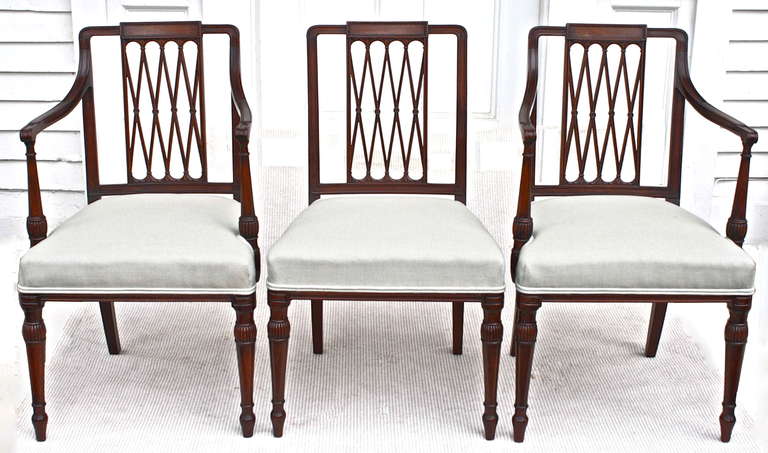
The Sheraton chair

The Sheraton chair was one of his designs done in the 18th century. The neo classical movement began in the mid-18th century and we can see how influenced he was by this style in his design. It has decorative aspects, delicate details, elegant artefacts and smooth edges. It is all finely carved by hand using heavy dense mahogany. It is quite a rich chair which was certainly designed for the rich or middle class.


Michael Thonet

Michael Thonet was one of the pioneers in the design of bent shaped furniture. After undergoing training in Germany Thonet went on to develop a steam process in order to soften the wood and allowing him to bend it easily. After several years working for other companies he set up his own factory to manufacture his own chairs in large numbers.  


Thonet and Sons Sessel No 14

Thonet’s No.14 Chair


The No.14 chair which is made out of benchwood is an early example of mass production, more than 15 million of them were made between 1859 and 1893. One of its main advantages was that it could be easily dissembled making it easier for transportation and exportation. Thonet was way apart from his time as his designs influenced modernism. It has a form follows function design, he only adds the relevant infrastructures of the chair without any fancy decorative carvings. It has quite a minimalistic design due to the few materials it has. Its curved legs help be stable even when heavy loads are applied. Thonet also considered practicality as the chair is light due to the low amount of materials it has. Some factors of how this chair made huge success were because it was cheap due to its ability to be built in mass production making it available for a wide range of markets and classes.


Conclusion 

In the two examples above I also managed to observe the different styles and mentalities of designers during the industrial revolution. Were Sheraton’s designs were decorative and luxurious, Thones designs were minimalist and practical. Both designers had different influences and aimed for different types of classes in society. Sheraton’s designs were done early on during the industrial revolution were craftsmanship was still at its peak, on the other hand, later on during the industrial revolution, Thonet saw the advantages in mass production and took the opportunity to boost his income by emphasising on practicality and reliability.